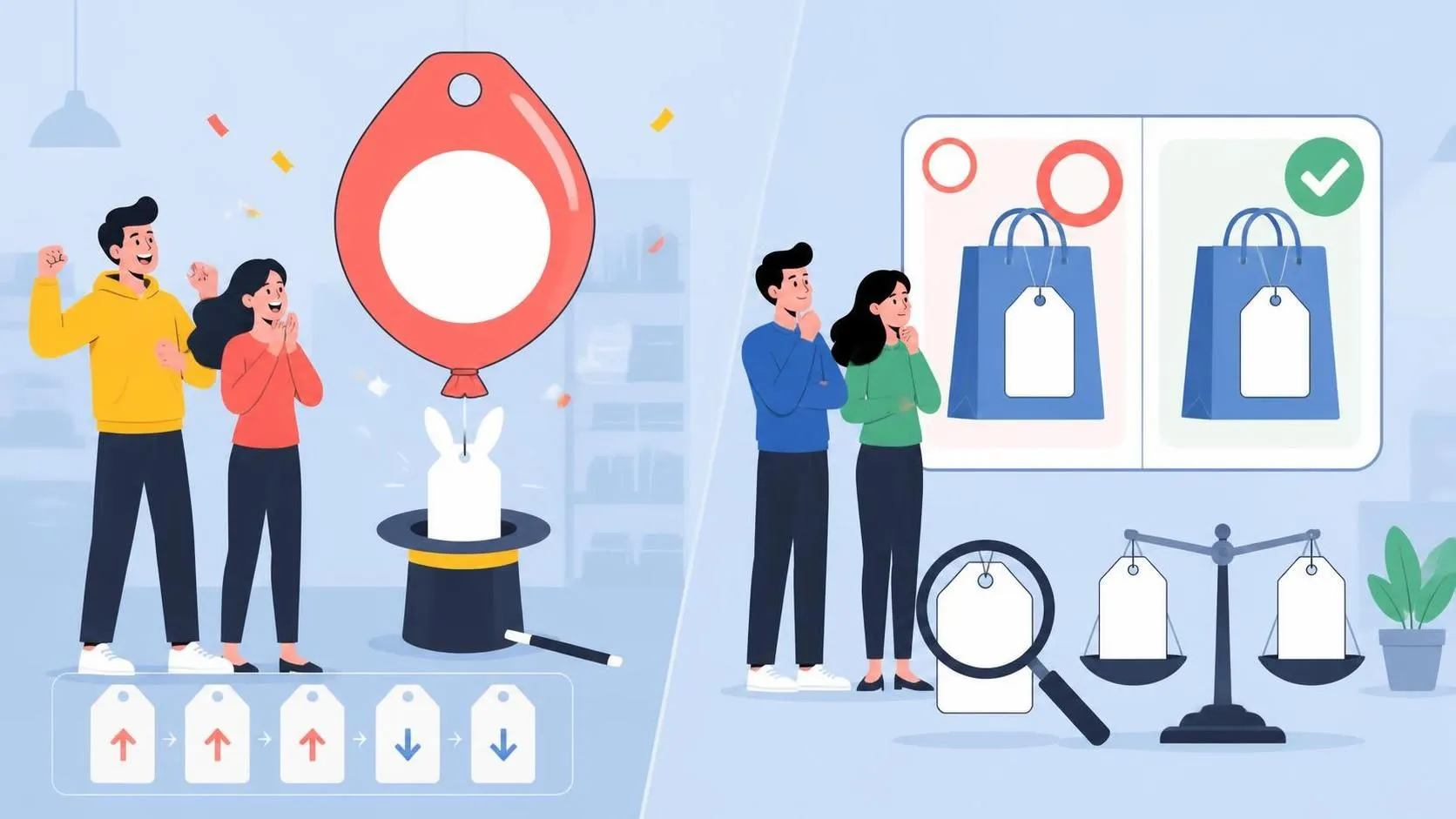
In many countries, Black Friday has become less about saving money and more about chasing a feeling: the door-opening rush, the countdown, the promise that “this is the lowest price.” For some shoppers, that promise is real—prices do drop on specific items, sometimes dramatically.
But for others, the experience feels like a magic trick. You walk in ready to win a bargain, only to find the “discount” is either smaller than advertised, applied selectively, or—worst case—built on a price that was quietly pushed up in the previous weeks.
That last tactic is often described as: a previous-week, arbitrary price increase so the Black Friday “discount” appears bigger than it truly is. In other words, the special offer isn’t special at all; it’s a rerun of an inflated baseline.
Special offers are not so special
A discount percentage can be emotionally powerful. “60% off” sounds like a deal regardless of context. The criticism is that this format can be misleading when the starting point is artificially raised.
Here’s the core problem:
- If the original price was increased earlier, then the “sale price” may look like a meaningful drop while actually returning the product to a normal or near-normal price.
- If the item’s price rarely returns to a pre-increase level, you may not be buying a discount—you may be participating in a temporary price cycle.
Even when there’s no outright fraud, the result can still be unfair because the shopper’s decision is guided by numbers that may not reflect genuine long-term value.
How the trick usually works
Many stores don’t need to do anything exotic. The mechanism can be simple:
- Prices are raised for a period before the sale.
- The store then labels the new, higher-but-now “reduced” price as a “discount.”
- Marketing highlights the discount percentage, while quieter details—like the price history—tell a different story.
Sometimes the raised price is broad; sometimes it’s targeted to popular items that will draw crowds. Either way, the shopper sees the headline and reacts.
What counts as a “real” deal?
A deal is usually “real” when at least one of these is true:
- The discounted price is lower than the item’s recent normal price, not just lower than an inflated “starting” price.
- The discount is consistent across time (for example, the price stays down meaningfully after the promotion ends).
- The discount applies to the item you actually want, not just a smaller, less useful model, accessory bundle, or alternative variant.
If none of those are true, the odds are higher that you’re looking at a presentation trick rather than a price improvement.
The common marketing tactics that create confusion
Below are several patterns that can make shoppers feel they’re getting a steal—even when they aren’t. Each one can distort your sense of value.
Percentage-off headlines that hide the baselineA “50% off” sign is impressive until you realize the previous price was raised shortly before.
What it does to you: It anchors your decision to a dramatic number rather than an accurate comparison.
Selective discounting (the “only some items” problem)Stores can advertise huge deals while discounting a narrow list of products. The crowd focuses on the headline—then discovers the best discounts are limited, out of stock, or applied to less desirable versions.
What it does to you: It creates disappointment and urgency-driven mistakes.
“Bundle” tricksSometimes the “discount” appears only after bundling. The product may still be overpriced as a standalone, and the bundle could force you to buy things you don’t need.
What it does to you: It turns “price comparison” into “value guessing.”
Practical steps to protect yourself
Here’s the part that actually helps: a straightforward approach you can use to decide whether the deal is genuine.
- Write down the exact item name (including size, model, capacity, color—whatever matters).
- Decide a target price you’d be happy paying.
- If you can’t define a target, you’re more likely to accept a “discount” just because it sounds large.
If you can, look at whether the price was lower in the weeks leading up to Black Friday.
- For example, if you want to buy a TV, go to the store at least three weeks before Black Friday fever and compare later (even quick snapshots help).
Black Friday is designed for speed.
- If you feel rushed, pause.
- Confirm the exact item, exact specs, and total price (including taxes/fees/coupons).
- If the deal depends on multiple conditions, verify them before assuming it’s “only good today.”
- Set one rule for yourself, such as “I only buy if it meets my target price.” It protects you from marketing-created urgency.
- Instead of relying only on “% off,” calculate what you’re truly saving.
- If you only know the store’s “strikethrough” price, you don’t actually know the savings—you only know the store’s claim.
Ask Questions
No. Some items genuinely drop in price, and some retailers reduce prices for real reasons (inventory planning, limited-time promotions, competition). The criticism is about how the discount is presented and how the baseline may be manipulated.
Because the percentage depends on the “before” price. If the “before” price was increased earlier, the sale price may be close to normal—or even still higher than it should be—despite a dramatic percentage.
Use a stronger decision rule: decide your target price first, and if the deal doesn’t reach it, pass—this way, even without history, your own threshold helps reduce the chance you’ll be pulled in by marketing.
When the “discount” relies heavily on a strikethrough price you can’t verify, especially if you remember the item being cheaper recently or you see a pattern of major price swings right before the sale.
Before Black Friday, pick the exact items you want and set a target price. During the sale, compare total cost and verify that the “discount” beats a reasonable baseline—not just the store’s headline.
You can also avoid shopping at all (except for groceries) during that period, like I do.