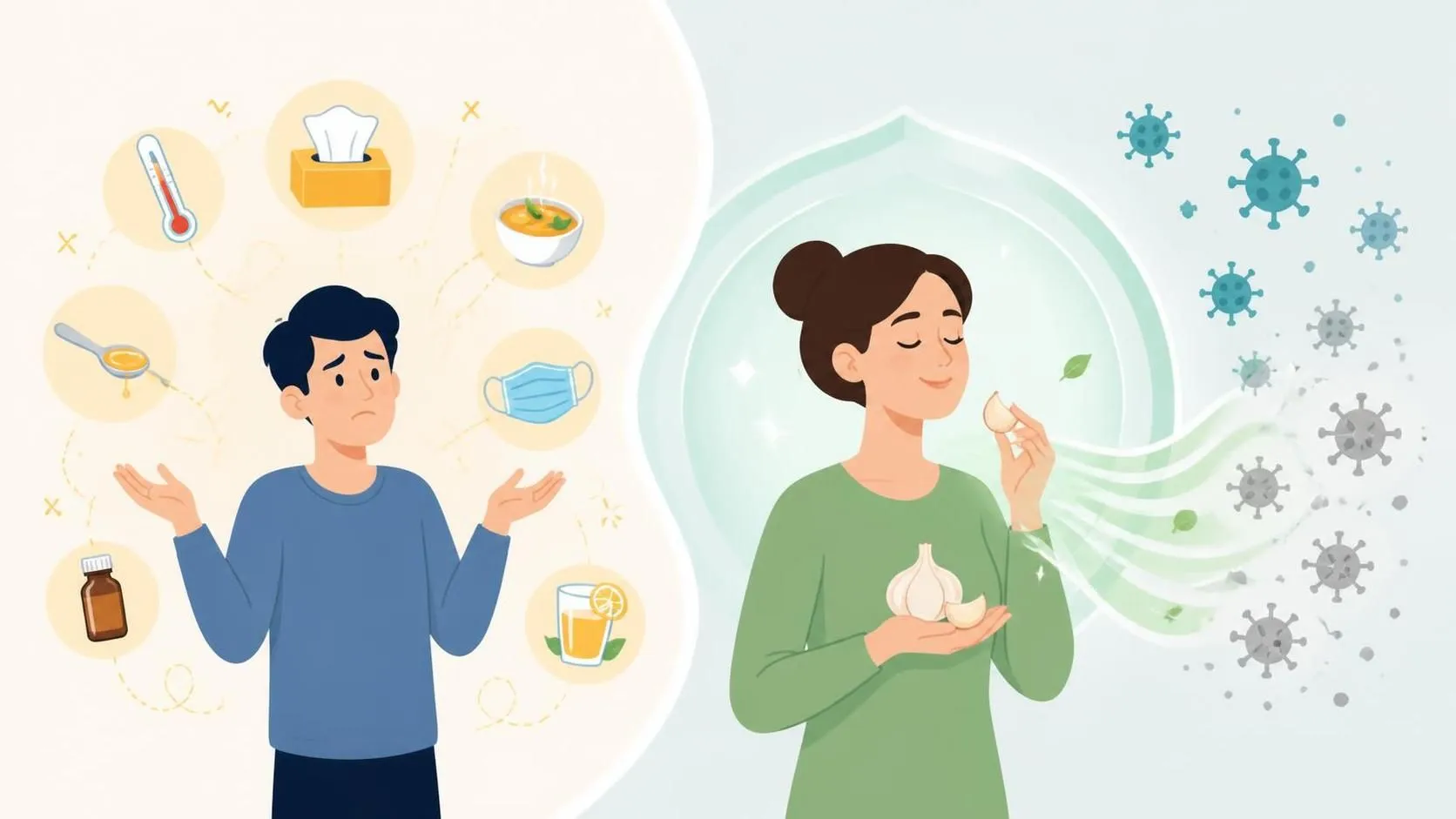
When I start feeling a cold or what might become the flu, I get surrounded by the same noise: painkillers, “immune boosters,” vitamin C pills, more tea, another remedy—like each one is a separate off-switch for the virus.
That’s the part I criticize. I’m not arguing that people are wrong to seek relief. I’m criticizing the message structure: it makes me believe there’s a neat pile of actions that will “solve the flu,” when most of what we do early is actually comfort, not a direct kill-switch.
And then there’s garlic—raw garlic in particular—that doesn’t fit neatly into the same TV slogan. It’s not marketed as the hero. It’s treated like a kitchen ingredient. But that’s exactly what makes my experience feel important: when I use raw garlic early, I feel like it actively changes the trajectory of symptoms fast—sometimes within a day.
What I’ve learned from experience (my “one-day reset”)
I’ll be very direct about the criticism: I’ve watched myself and people I know get pulled into a loop where remedies multiply, but the illness doesn’t meaningfully stop—it just gets managed.
In my case, raw garlic has been different. When I eat it with regular food (so it’s not this stressful “only garlic” challenge), I notice an early shift: the initial symptoms don’t keep escalating the way they usually do, and I often feel like the worst part breaks within about a day.
That doesn’t mean it’s guaranteed. It means my body reacts in a way that feels more “active” than “supportive.”
I’m critical of how flu and cold treatment gets marketed as a pile of quick fixes—like painkillers and supplements are the real “battle plan.” For me, raw garlic stands out because it doesn’t just soothe; it seems to change the direction of symptoms early. Even if scientific evidence isn’t definitive, my experience is that the right tool at the right moment can outperform the noisy crowd of remedies—and that’s exactly why I push back against the usual “more remedies = better results” culture.
Paracetamol (acetaminophen): why too much can harm the liver
My criticism becomes sharper when I compare garlic with the way paracetamol is often used.
Paracetamol works mainly for pain and fever. It doesn’t treat the virus directly. But the big danger is dose confusion: people don’t always realize how many cold/flu products contain paracetamol, and “a little more” can quietly become “too much.”
The liver damage mechanism is very specific:
- Paracetamol is metabolized in the liver.
- At usual doses, most of it becomes harmless by-products.
- When dosing is too high (or repeated in a way that exceeds safe limits), a toxic metabolite (NAPQI) is produced faster than the body can neutralize it.
- This depletes glutathione defenses and can lead to liver cell injury.
Why garlic fits my point of view better than the usual stack
Here’s how I see it:
- Most remedies people reach for are symptom managers (they help me feel less bad).
- Raw garlic—based on how I experience it—acts more like a direct attacker on the early phase.
- Even if the scientific evidence isn’t overwhelming or conclusive, there’s a real-world pattern in my experience that looks like something biologically strong is happening.
So my criticism isn’t “science is irrelevant.” My criticism is: the public story often assumes that “not proven fully yet” means “doesn’t matter,” when in practice, I’m the one living through the illness timeline. My experience is not a lab paper, but it’s still data.
How garlic “works inside the body”
When I say raw garlic can help against a cold and (in my experience) even flu-like symptoms early, I’m not describing a magical switch. I’m describing a chain reaction that starts after eating—and that’s the metaphor I hold onto.
Think of my body like a busy neighborhood under early attack. I (and many people) notice the first signs and assume the solution is an external “button” you press immediately. TV and parents often push that model: take this pill, the problem will be gone.
But once garlic is eaten, it breaks down into active sulfur-containing compounds, and those compounds interact with biological systems through the body. That’s why my experience feels different: I’m not only soothing symptoms—I’m using something that seems to get active internally rather than only covering discomfort.
At least in my lived experience, garlic feels like a different kind of intervention: it starts working after ingestion through internal chemistry, not only through symptom masking—hence why I treat it as an early, practical bet.
Try it and let me know if you recovered fast or not.
Practical steps
I keep it simple because I’m tired of the “add everything to the pile” mentality.
- Don’t wait until you feel fully miserable. If I’m going to try raw garlic as an early intervention, I do it when symptoms first show up. And most importantly, eat it raw and with each meal during the day.
- I don’t eat it alone unless I have to. I treat it like an ingredient inside a real meal—something that’s sustainable, not something I dread.
- This is my biggest criticism: people stack painkillers, cold meds, supplements, and “boosters” like the universe will reward effort. I’m trying to avoid the “too many buttons, no diagnosis” approach.
- I still drink fluids and rest. But I don’t let comfort measures become an excuse to over-medicate or over-stack.
- After one year using only garlic (plus water and rest) I’m firm on my experience—yet I would advise that if things turn worse in a way that feels dangerous, you switch to getting proper medical help rather than bargaining with the illness.
Ask Questions
No. My point is that it often feels powerful in the early phase for me. I’m not claiming certainty. I’m criticizing the certainty people are sold by TV-style remedy culture.
Maybe you experiece cold combined with other diseases with make your body even weaker to fight infections.
Because I can’t ignore my own timeline. When I see a fast break in symptoms after doing something consistently, I treat that as meaningful—even if it isn’t backed by perfect evidence.
The harm is the obsession with “doing more” instead of doing what’s actually effective early. And yes—sometimes the harm is direct: people can overuse things like pain relievers (including acetaminophen/paracetamol) while thinking they’re “fighting flu,” when they’re really just chasing symptom relief.
One early targeted food bet (raw garlic with food), basics for comfort, and less remedy stacking noise.
"Juice" (in most countries) contains only juice, while "juice drink" can be 10–99% juice mixed with water, sugars, and other ingredients. The label should specify, but marketing often obscures this distinction with similar packaging.